


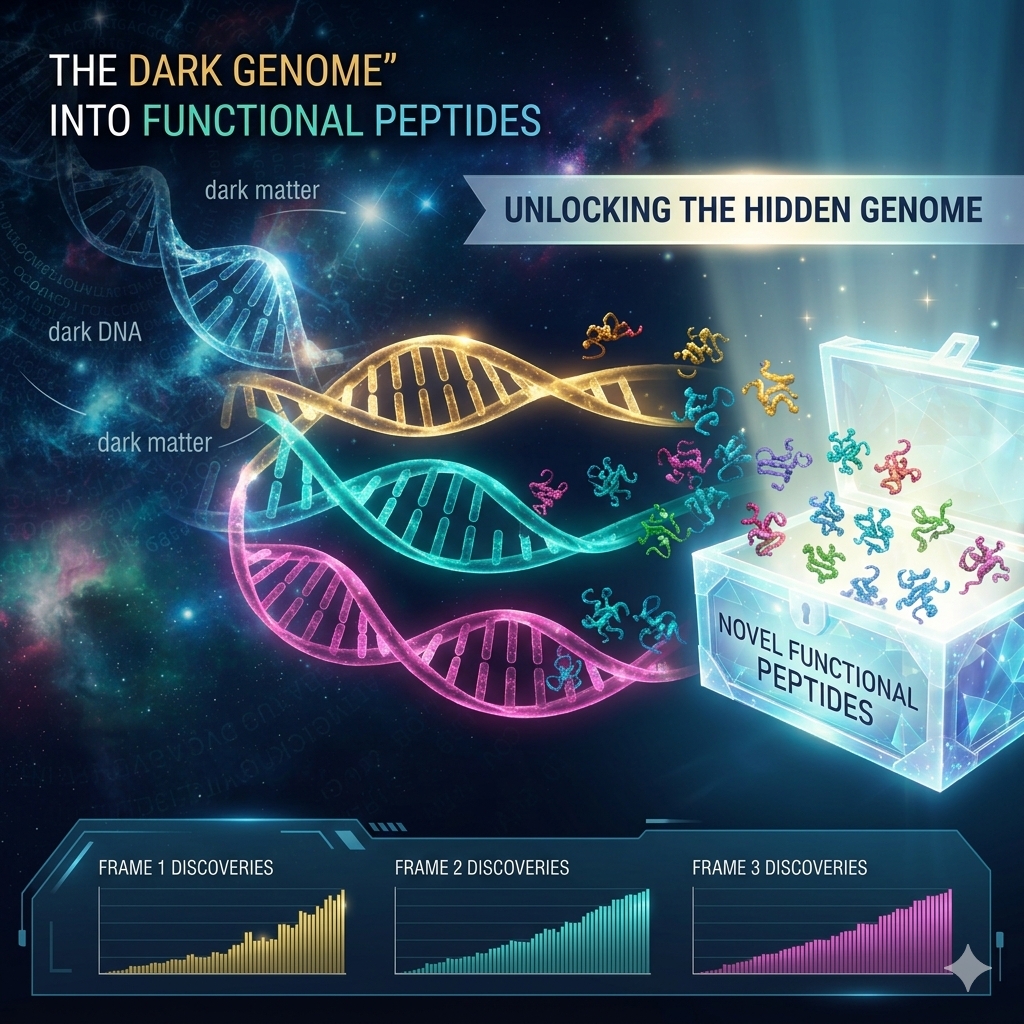
Alternative Open Reading Frames (altORFs): Find Novel Functional Peptides in Multi-Frame Translation
A single RNA sequence can carry more than one protein instruction. Change the codon grouping, and the same nucleotides produce a different amino acid chain. This simple fact has opened a rich area of research into alternative open reading frames, or altORFs, frame-shifted peptides, and the hidden proteome.
Many regions once labeled “noncoding” may support short-lived or tissue-specific translation. Others may sit inside known genes, upstream of them, or in a different reading frame. Researchers now combine ribosome profiling, proteogenomics, and cell-based tests to find which candidates become functional peptides. The result is a wider view of gene activity, with possible uses in disease research, drug design, and biotechnology.
How Alternative Open Reading Frames Expand Peptide Discovery
One transcript can encode several peptide sequences
An open reading frame, or ORF, begins with a start codon and ends at an in-frame stop codon. On a DNA strand, three reading frames are possible because translation reads bases in groups of three. The reverse strand adds three more potential frames, while an RNA transcript usually presents three direct reading options.
A canonical protein-coding region uses one main frame. An upstream ORF, downstream ORF, overlapping ORF, or embedded ORF can use another. A frame shift changes every codon after the shift, often producing a distinct peptide rather than only damaging the original protein.
Genome annotations capture only part of translation
Older gene catalogs favored long coding sequences with strong conservation. Newer studies find translation in short ORFs, noncoding RNAs, untranslated regions, and alternate frames. This has expanded the search for microproteins and other noncanonical translation products.
A translated ORF has evidence of ribosome activity. A functional ORF changes a biological process. A biologically validated ORF has stronger proof, such as peptide detection, a defined molecular interaction, and a reproducible phenotype. Ribosome occupancy alone cannot establish a peptide’s role.
Small peptides can have large effects
Peptide length does not predict biological value. A short product may sit in a membrane, enter a mitochondrion, bind a larger protein complex, or alter a signaling pathway. Some microproteins affect ion transport, metabolism, stress responses, or immune recognition.
Functional altORF products also differ from random protein fragments. Their production may begin at a reproducible start site, follow a defined reading frame, and change when researchers disrupt translation. Those details help separate active peptides from incidental degradation products.
How Ribosome Profiling Reveals Alternative Open Reading Frames
Ribo-seq maps active translation
Ribosome profiling, or Ribo-seq, sequences RNA fragments protected by ribosomes. Since ribosomes move in three-base steps, a strong three-nucleotide pattern supports active translation in a particular frame. Start-codon enrichment and stop-codon patterns can improve ORF boundary estimates.
Ribo-seq has limits. Low-abundance translation, tissue-specific expression, sample quality, and technical noise can hide real products. A footprint also shows ribosome engagement, not a proven peptide function.
Mass spectrometry confirms peptide production
Mass spectrometry can detect altORF-derived peptides at the protein level. Researchers must build custom search databases that include predicted alternative sequences. Standard databases often exclude these products, so a real peptide can be missed during analysis.
Short, hydrophobic, unstable, modified, or tissue-restricted peptides remain hard to measure. Synthetic peptide standards and targeted methods such as parallel reaction monitoring provide stronger support than a single database match. Orthogonal tests, including antibody detection or tagged constructs, add confidence.
Functional screens filter biological noise
Researchers can test candidates with CRISPR editing, start-codon changes, premature stops, synonymous recoding, and rescue experiments. A rescue construct that restores the peptide but not the original RNA sequence can help link a phenotype to translation.
The design must separate peptide effects from RNA effects. Researchers measure RNA stability, transcript location, neighboring gene activity, and protein expression alongside cell growth, localization, metabolism, stress response, or protein binding. This turns a predicted altORF into a testable biological claim.
How altORFs Add New Layers to Cell Biology
Overlapping peptides can alter known pathways
An altORF inside or near a canonical gene can produce a peptide within the same regulatory setting. It may compete for a binding partner, membrane site, chaperone, or organelle-targeting system while leaving the main protein sequence unchanged.
The CDKN2A locus provides an established example of overlapping coding information. In humans, p16INK4a and p14ARF use different reading frames and distinct first exons within the same locus. This example is not identical to every newly found altORF, but it shows how compact DNA regions can encode separate proteins with different roles.
Microproteins can control complexes and organelles
Several validated microproteins show why short sequences deserve close study. DWORF regulates the cardiac calcium pump SERCA2a by affecting its interaction with phospholamban. MYMX, also called myomixer, is a muscle-specific micropeptide involved in myoblast fusion.
Other small proteins associate with mitochondria, the endoplasmic reticulum, membranes, or stress pathways. AltORF research may add more compact regulators to these groups, though each candidate needs source-specific evidence and direct testing.
Hidden peptides may affect immunity and disease
Noncanonical peptides can enter the MHC class I antigen-presentation pathway. Tumors, infections, and cellular stress may increase translation from ORFs that are rarely active in healthy tissue. Such products could become biomarkers or targets for T-cell therapies.
Disease-linked mutations can also create new frames, remove stop codons, or change translation control. Cancer-associated ORFs and disease-specific proteome changes offer useful leads, but detection alone does not prove clinical value. Researchers must connect the peptide to immune recognition, disease biology, or a reproducible treatment response.
A Validation Pipeline for Functional altORFs
Prioritize candidates with several signals
Random ORF searches produce too many possibilities. Stronger candidates show reproducible ribosome periodicity, clear initiation and termination, peptide-spectrum support, or amino acid conservation. Tissue-specific expression, stress induction, predicted localization, and peptide stability can help rank them.
A candidate with a measurable phenotype is easier to test than one with no known cellular context. Structural predictions and interaction data may suggest whether a peptide binds a membrane, enzyme, channel, or larger protein complex.
Prove the phenotype depends on translation
Start-codon alteration and premature-stop mutations can disrupt peptide production. Synonymous changes help preserve the RNA sequence while changing the encoded peptide, while rescue constructs test whether restoring the product restores the phenotype.
Good experiments also track transcript levels and location. An edit that changes RNA stability or affects a neighboring gene can create a misleading result. The strongest design compares RNA-preserving edits, translation-blocking edits, and peptide rescue.
Combine independent lines of evidence
A convincing altORF study often joins Ribo-seq, mass spectrometry, imaging, interaction assays, biochemical tests, and gain- or loss-of-function data. Replication in relevant tissues, model organisms, or patient-derived cells adds weight.
Negative results also matter. Translation may occur only during stress or in a rare cell type, and a peptide can fall below standard detection limits. Reporting those limits helps distinguish missing evidence from evidence of absence.
Discovery Bottlenecks Create New Research Opportunities
Incomplete annotations hide real candidates
Reference annotations may miss transcript isoforms, alternative splicing, non-AUG initiation, RNA editing, and condition-dependent translation. A transcript-specific ORF search can reveal products that a single genome annotation overlooks.
The field also needs consistent names and evidence tiers. Clear labels can separate predicted ORFs from translated products and fully validated functional peptides.
Detection tools favor abundant products
Mass spectrometry favors peptides that are stable, soluble, abundant, and easy to extract. Unstable products, membrane peptides, modified sequences, and rare cell-specific products can disappear during sample preparation.
Better enrichment, targeted proteomics, immunopeptidomics, long-read sequencing, and spatial transcriptomics should improve detection. Every study should report sample details, detection limits, and peptide-confidence rules.
Therapeutic use requires selectivity
AltORF products could support peptide replacement, inhibitory peptides, molecular glues, vaccine antigens, antibody targets, T-cell therapies, or gene-editing strategies. Their small size may help with design, but delivery remains difficult.
Protease breakdown, intracellular access, tissue targeting, immune reactions, and off-target binding must be tested. Sequence novelty alone cannot support a treatment claim. Mechanistic studies and in vivo results must come first.
Conclusion
Alternative open reading frames expand the number of peptide sequences that existing transcripts can encode. Ribo-seq can suggest active translation, proteogenomics can detect the product, and genetic and biochemical tests can show whether it changes cell behavior.
The best discoveries follow a clear chain: predicted ORF, active translation, peptide detection, molecular mechanism, and reproducible phenotype. AltORFs do not replace canonical genes. They add another layer of regulation and function.
The most promising areas include microprotein biology, cancer immunology, rare diseases, biomarkers, and precision therapies. Sequences once dismissed as annotation gaps or translation noise may contain functional peptides worth testing. Continued work on better maps, cleaner experiments, and selective delivery will turn more of those hidden instructions into useful biology.